The Mastodon scheduler that plans, writes and posts for your clients on any server.
SocialScheduler plans each client's Mastodon week, writes posts within their server's character limit and adds alt text to every image. You or the client approve, and each post goes out when their followers are online.
A Mastodon scheduler publishes posts to a Mastodon account at a time you choose. Mastodon supports scheduling only through its API, so you need an app or a tool. SocialScheduler is a Mastodon scheduler for agencies: its AI plans each client's week, writes each post within that server's character limit, adds alt text to images, and publishes on any Mastodon server once you or the client approve.
Free for one client. No credit card.
Mastodon scheduling at a glance
- Post length
- 500 characters by default; each server sets its own (infosec.exchange allows 11,000)
- Media
- Up to 4 images or 1 video per post; images up to 16 MB (Mastodon docs)
- Alt text
- Up to 1,500 characters per image (Mastodon docs)
- Native scheduling
- API only, at least 5 minutes ahead; no schedule button in the official apps (Mastodon 4.7)
- Users
- About 976,000 monthly active on 8,750 servers (FediDB, September 2026)
- Discovery
- Chronological home feed; reach comes from hashtags, follows and boosts
- Free plan
- 1 client, 3 accounts, 20 AI credits a month
- Checked
- September 2026
Every Mastodon format your clients use.
Planned on Sunday with the rest of the week. Written in the client's voice. Designed in their brand.
Text posts
500 characters by default, or the server's own limit, counted before scheduling.
Image posts
Up to 4 images, a photo or one the AI designs, each with alt text.
Video
One video from the client's media library.
Any server
mastodon.social, a niche server or the client's own.
How the AI writes for Mastodon.
The limits and habits of the network are built in. Every post is checked against them before it is scheduled.
- Counted against the server's own limit, content warning included
- Connects with the server's own login, no password shared
- One to three CamelCase hashtags at the end
- Alt text on every image
- Written for Mastodon, not cross-posted
- Public, at the client's best hour
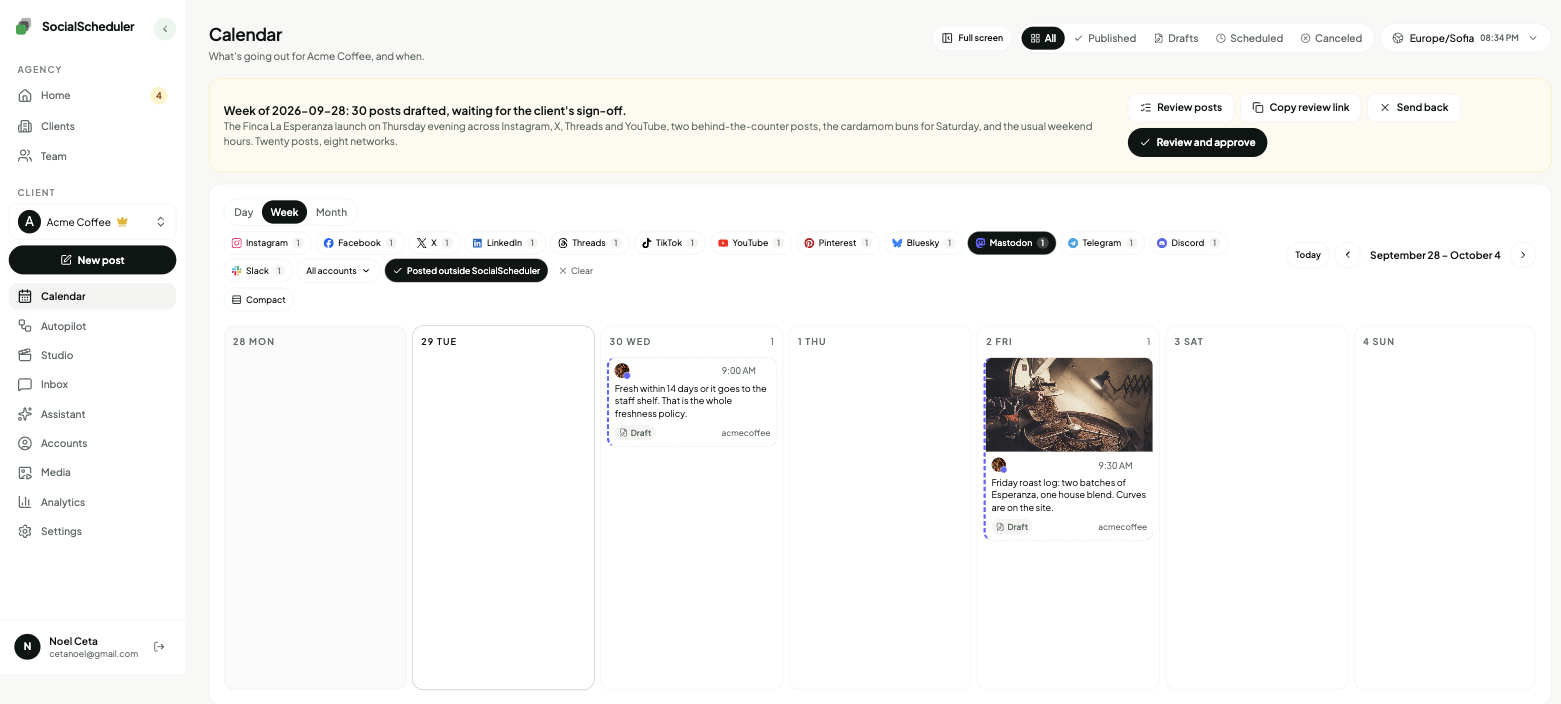
Planned Sunday. Waiting for approval.
- Tue09:00TextHow we pick a green coffee, in four steps.
- Thu13:00ImageThe roaster at 6am. Quiet, loud, then quiet again.
- Sat10:30TextSaturday question: grinder or kettle, which upgrade first?
You choose who says yes.
Per client. Change it any time. Your team can pull any Mastodon post until it goes out.
Agency reviews
DefaultYour team approves the week in the app. Nothing goes out before.
Client signs off
Most usedThe client gets an email link. They approve or comment. No login.
Review link · no login needed
Dana (Acme) · approved Mon 10:12
Full autopilot
For trusted clientsNo approval step. It plans and posts. Everyone gets a Monday report.
Client report every Monday, 9:00
Pause any time, pull any post
Why Mastodon is worth it for brands and agencies
Mastodon is a free, open-source social network made of thousands of independent servers that talk to each other through the ActivityPub protocol, the backbone of the fediverse. FediDB counted about 976,000 monthly active users on 8,750 Mastodon servers in September 2026. That is small next to Instagram, but the audience skews toward tech, science, open source, journalism and public institutions.
Two things make it different. There are no ads and no ranking algorithm: the home feed is chronological, so every follower sees every post in order. And nobody can throttle the reach you built. For a client that sells to developers, researchers or a privacy-minded crowd, a steady Mastodon presence is an owned audience that costs little to keep.
Choosing a Mastodon server for a client
Every Mastodon account lives on a server, also called an instance. The server sets the rules, the moderation and the post length. mastodon.social is the largest general server. Topic servers such as infosec.exchange or fosstodon.org put a brand next to its niche, and a client can also run its own server on its own domain.
A few checks help. Read the server's rules, since some do not allow commercial accounts. Check the character limit: 500 is the default, but some servers allow far more. Then add a link to the client's website on the profile, with a matching rel="me" link on the site, so Mastodon shows it as verified. SocialScheduler connects to any server and reads its limit when you connect.
What an agency week looks like
Each client has a brief: voice, offers, topics to avoid, links. On Sunday the AI plans the client's week across every network they use and writes a separate Mastodon version of each idea: plain, useful, in the client's voice, without engagement bait.
Then someone says yes. Your team approves in the app, or the client gets an email link to the week and approves, comments or asks for a change without a login. Clients you trust can run on autopilot. On Monday each client gets a report under your agency's name, with followers, favorites, replies and boosts.
- Sunday: the week is planned and drafted
- Review: your team or the client approves from a link
- During the week: posts go out at each client's best hours
- Monday: a report under your agency's name
The best time to post on Mastodon
There is no large public study of Mastodon posting times as of September 2026, unlike Instagram or Threads. The reason is structural: there is no central company collecting the data. Much of the active audience is in Europe and North America, so weekday mornings in Europe, which overlap with early US hours, are a common starting point.
The better answer is the client's own followers. Because the feed is chronological, a post is seen mostly by people who open Mastodon in the hours after it goes out. SocialScheduler looks at when each client's audience is active and how past posts did on favorites and boosts, and schedules each post for that client's best hour. You can move any post.
How Mastodon scheduling works, and the free option
Mastodon has supported scheduled posts in its API since 2019. A post can be set for any time at least 5 minutes ahead, but the official web and mobile apps have no button for it. Free apps such as Tusky, Fedilab and Phanpy use that API, which is enough for one person with one account.
SocialScheduler connects through the server's own OAuth login, so it never sees the password. It registers itself on the server the first time anyone connects from it, keeps posts in its own calendar and publishes at the chosen time. The free plan covers one client with up to 3 connected accounts and 20 AI credits a month; publishing never costs credits. Business is $49 a month for 5 clients and Agency is $149 a month for 15, with 20% off yearly.
One plan, every network.
Each client's week is written once, then sized for every network they are on.
- Mastodon schedulerThis page
- Bluesky scheduler
- Threads scheduler
- X scheduler
- Instagram scheduler
- TikTok scheduler
- Facebook scheduler
- LinkedIn scheduler
- YouTube scheduler
- Pinterest scheduler
- Telegram scheduler
- Discord scheduler
- Slack scheduler
Also publishes to Reddit, Google Business Profile, Dev.to, Hashnode, WordPress, ListMonk and Lemmy.
Mastodon questions, answered.
Yes, but not from the official apps. Mastodon's API accepts a scheduled time at least 5 minutes ahead, and apps and tools such as SocialScheduler use it or publish at the chosen time for you.
One that handles many clients on many servers without shared passwords. SocialScheduler plans and writes each client's Mastodon week, lets clients approve from an email link with no login, and sends a Monday report under your agency's name.
Yes. FediDB counted about 976,000 monthly active users on 8,750 Mastodon servers in September 2026, with mastodon.social alone reporting about 270,000. Activity is concentrated in tech, science, open source and journalism.
Yes. Mastodon is free, open source and has no ads; most servers run on donations. SocialScheduler's free plan covers one client with 3 accounts and 20 AI credits a month.
500 characters on a default server, including any content warning. Each server can set its own limit, and some allow thousands. SocialScheduler reads the limit of each client's server and checks every post against it.
Up to 4 images, or one video, on a default server. Each image can carry alt text of up to 1,500 characters, and SocialScheduler adds it to every image.
Any Mastodon server. Enter the server's address, such as mastodon.social, and sign in there. SocialScheduler never sees the password.
No large study exists as of September 2026. Weekday mornings in Europe, which overlap with early US hours, are a common starting point, but the best hour depends on when the account's followers are online.
Bluesky has the larger audience and feels closer to X. Mastodon is smaller and spread across independent servers, with a strong following in tech and science and no algorithm between a brand and its followers. Many agencies post to both, written separately for each.
No. The SocialScheduler inbox covers Instagram, Facebook, Threads, X, YouTube and Bluesky. Mastodon replies are answered on Mastodon itself.
Yes. SocialScheduler only uses official APIs. No browser automation, no shared passwords.
Yes. The client gets an email link with the week and can approve, comment or ask for a change. No login. Or your team approves, or you turn on autopilot for clients you trust.
Facts on this page reviewed
Start with one client.
Ten minutes to set up. The first week is planned right away.